Moira Nicholson
Why Didn't They Ask EvansMoira Nicholson first appears as a beautiful, anxious young woman whose large eyes seem to invite sympathy. That impression is not wholly false: she tells Bobby Jones that she fears her husband and has nowhere else to go. But her account of danger masks a more consequential truth. She has travelled under assumed names, helped ensnare John Savage, and returned to Staverley after his death. Her character depends on the gap between the vulnerable wife others think they see and the practiced conspirator later exposed.
Identity and Introduction
Moira is married to Dr Jasper Nicholson, a Canadian physician who runs a sanatorium for people with nervous disorders and drug problems. At dinner with Frankie Derwent and Sylvia Bassington-ffrench, she seems nervous and talks feverishly, while her husband’s imposing manner makes a striking contrast. Sylvia describes Moira as pretty and charming, with wistful eyes, and suspects that she is unhappy. Sylvia’s abrupt, emphatic dislike of Dr Jasper Nicholson gives the marriage an early atmosphere of unease, though it does not yet explain what lies behind it.
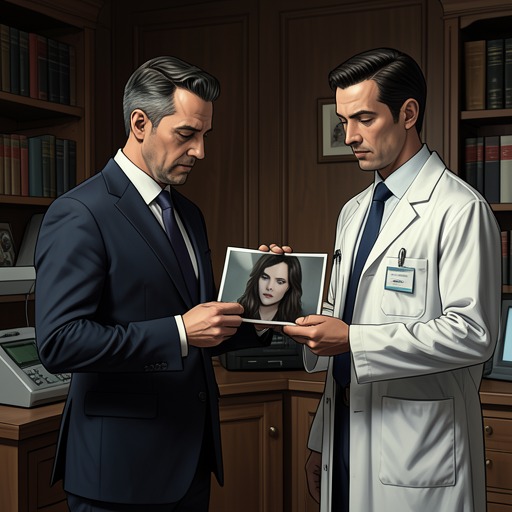
A photograph supplies Moira’s first link to the mystery surrounding Alan Carstairs. Sylvia identifies the pictured woman for Frankie as Moira and recalls that a visitor had been struck by her face and wanted an introduction. Later, Bobby finds the woman from the photograph waiting for him in a private room at the Anglers’ Arms. She sits upright, dressed in black, too nervous at first to speak; her hands move restlessly and her expression conveys a frightened appeal. Bobby initially understands her as the distressed woman in Alan’s photograph, not as someone connected to the larger criminal plot.
Appeal to Bobby Jones
Moira identifies herself as Dr Jasper Nicholson’s wife and insists that she is not a patient at his sanatorium. She says she believes he wants to kill her, and describes a series of apparent accidents: he once backed a car toward her without seeing her, and on another occasion a substance was put in the wrong bottle. She says that the incidents could be dismissed individually, but that constant watchfulness has exhausted her. She has felt unsafe for just over a year, yet says she cannot leave because she has neither money nor somewhere to go, and doubts anyone would believe her story. Bobby takes her fear seriously and offers belief rather than dismissal.
The conversation also establishes that Moira knew Alan before her marriage and had given him her photograph. Alan visited her about a month before his death, although she says she had not written to him since marrying and had not told him where she lived. She had not then begun to suspect her husband, and says she tried to conceal that the marriage was unhappy. She denies discussing her fears with Alan. When Bobby tells her that Alan fell from a cliff at Marchbolt on October 3 and had her photograph in his pocket, she responds with sadness and calls him faithful. The exchange makes the photograph more than a clue to a mistaken identity: it records a real attachment from Moira’s earlier life, though the evidence does not establish what Alan knew about her later activities.
The Hidden Identity and the Savage Scheme
The revelation of Moira’s criminal role comes through Roger Bassington-ffrench’s account of the plot. He says she travelled under different names because of complications in the drug business, and that she was using the name Mrs Templeton when she met John Savage. She learned of Savage’s wealth and deliberately sought to attract him. A man known as Cayman played the part of an unfeeling husband, helping induce Savage to stay at Tudor Cottage. On his third visit, the conspirators put their plan into action; Moira took the money and went abroad in appearance, but returned instead to Staverley and the Grange.
This account recasts her marriage and her reported fear. In her conversation with Bobby, Moira presents herself as a woman trapped by poverty and a threatening husband. Roger’s explanation presents her as a participant in a scheme that used a false identity and a staged domestic situation to gain access to Savage’s money. The two accounts are not equal in circumstance: her fear is what she tells Bobby, while the later explanation is given by Roger as part of his confession. Together, however, they show how readily the appearance of helplessness could function as cover within the plot.
Criminal Partnership and Exposure
Roger also describes a plan to remove Henry Bassington-ffrench and Tommy Bassington-ffrench from the way. After attempts to arrange accidents involving Tommy failed, Roger says he introduced Henry to morphia and intended for him to die at the Grange, either by apparent suicide or an overdose. Moira, according to Roger, was to carry out that part of the plan, while Roger kept himself at a distance. His account places her not merely among the people who benefited from Savage’s death but within the continuing conspiracy around the Bassington-ffrench family.
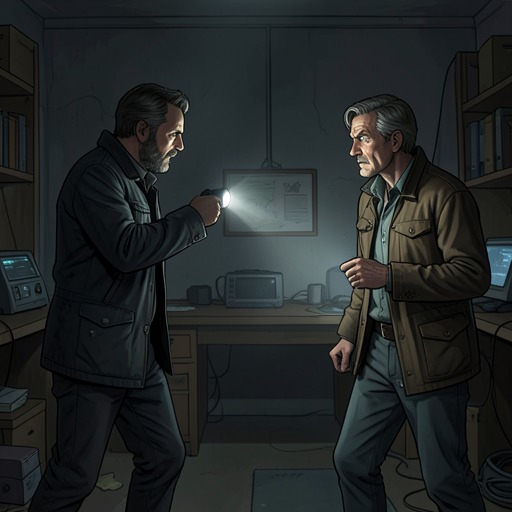
At the cottage, Moira recognizes from the noise upstairs that Roger has been knocked out. Roger says she injected herself with a large dose of morphia, lay down, and later went to the attic to cut him free while Bobby and the others went to telephone. By the time the doctor arrived, she was genuinely in a hypnotic sleep. Roger presents this action as a rescue concealed by an apparent medical crisis: her own knowledge of morphia lets her create a convincing explanation for her absence and then assist him without immediately drawing attention to what she has done.
Roger says that Moira’s composure was failing because she feared Bobby would discover Evans and understand the fraud surrounding Savage’s will and death. She also feared Alan might have written to Evans before travelling to Marchbolt. Instead of going to a London nursing home as she pretended, she hurried to Marchbolt and encountered Bobby and Frankie at the door. Roger says she then wanted both of them removed so the investigation would collapse. Her attempt to keep the scheme concealed was therefore tied to specific threats: the possibility that Evans could expose the will, and the possibility that Alan had left information behind.
Character and Narrative Role
Moira’s decisive change in the reader’s understanding comes through reversal rather than a wholly new appearance. The photograph first links her to Alan; her meeting with Bobby makes her seem like a threatened witness; Roger’s later account reveals her as an organizer and accomplice. Her nervousness and reported fear cannot, on the evidence available, be treated as proof of innocence or as proof that every part of her account was false. What becomes clear is that she was able to occupy the role of endangered wife while concealing her participation in crimes.
Her story also shows how the plot repeatedly makes identity difficult to verify. Moira’s use of several names, including Mrs Templeton, lets her move between different social settings and approach people under a constructed identity. The photograph, which seemed to offer Bobby a stable means of recognition, connects Alan to Moira but cannot by itself explain which version of her history is true. In that sense, Moira is central to the book’s pattern of appearances that resemble accident, illness, or vulnerability while serving a deliberate scheme.
Roger says that Moira eventually lost her nerve and implicated him at trial, and adds that he had begun to tire of her. The account thus closes not with a return to the helpless figure who asked Bobby for help, but with the conspirators’ partnership breaking down under exposure. Her final significance lies in that contrast: the frightened appeal was persuasive enough to win Bobby’s trust, while the later revelations make the same performance part of the mystery he had to solve.